MSR 2026 - Modeling Sampling Workflows for Code Repositories
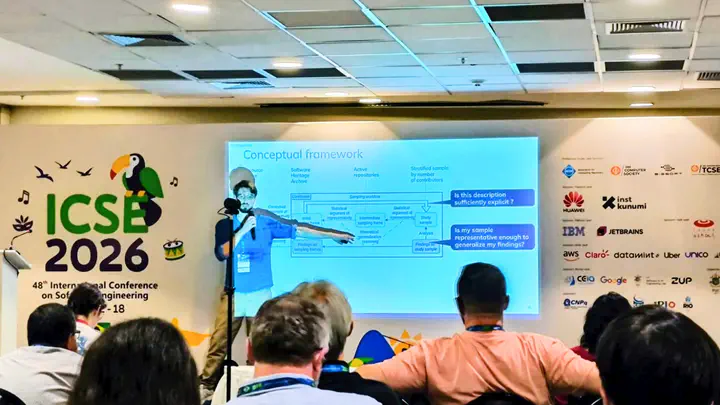
Empirical software engineering research depends heavily on datasets of software repository artifacts. Since studying an entire population is rarely feasible, researchers rely on sampling — selecting a subset of elements from an accessible portion of the population. But in practice, obtaining a sample from a software archive is never a single step: it involves filtering, grouping, drawing randomly, and merging intermediate datasets. These multistage processes don’t fit neatly into the classical population → sampling frame → sample framework, and describing them in natural language leaves critical decisions implicit, ambiguous, and impossible to reproduce.
As part of my PhD, we tackle two related challenges: (1) how to explicitly describe complex multistage sampling strategies, and (2) how to reason about their representativeness to support generalization claims.
A DSL for sampling workflows
We propose a Domain-Specific Language (DSL) that models sampling strategies as workflows: each node represents a collection of items (an intermediate dataset), and each arc a transformation — Filter, Random, Systematic, Grouping, Set operators. Classical strategies like stratified random sampling or cluster sampling emerge naturally as compositions of these primitives.
The DSL is implemented as a Python fluent API, executable on real datasets. We provide a built-in connector to Software Heritage datasets, enabling workflows to run directly on an a datasets of 27M+ repositories.
Automatic representativeness reasoning
Having an explicit workflow structure opens the door to automated statistical analysis. The tool derives the needed statistical indicators to justify representativeness arguments in theoretical generalization reasoning between a sample and its sampling frame :
- Distribution similarity — Kolmogorov-Smirnov and Chi-square tests comparing each intermediate set to its parent
- Sample size adequacy — Cochran’s formula applied at each Random Operator to verify the sample is statistically sufficient
- Breadth analysis — coverage of metadata classes across the sampling frame
Try it
pip install sampling-mining-workflows-dsl
- Paper: hal.science/hal-05478146v2
- Code & replication package: github.com/RomainLefeuvre/SamplingMiningWorkflowDSL